Short answer: To create a WordPress payment form with Easy Form Builder, switch to the free Free Plus plan, install the Stripe or PayPal payment add-on, paste your keys under Settings » Payments, start from the Payment Form template, add prices and one gateway field, then publish the shortcode. One-time and recurring payments work without a Pro license.
Quick facts
- Plan: Free Plus (free of charge) + Stripe Payment Add-on or PayPal Payment Add-on
- Time: about 10 minutes
- Tested with: Easy Form Builder 4.3.1 on WordPress 7.1.4
- Last verified:
- Requires: a Stripe or PayPal account (Stripe test keys or PayPal sandbox credentials are enough to follow along)
- Requires: HTTPS on your site before you take live payments
- Payment options: Stripe, PayPal and more
- Is the payment form free?
- Payment fields you can add
- Step by step: create the payment form
- Donation, subscription and order forms
- Troubleshooting
- Frequently asked questions
WordPress payment form options: Stripe, PayPal and more
Easy Form Builder 4.3.1 takes payments through gateway add-ons. Stripe and PayPal are offered on every site; a third add-on, Persia Payment (ZarinPal), is listed only when the site language is Persian. This page is the overview. The full setup of each gateway has its own guide: how to create a Stripe payment form in WordPress and how to set up PayPal in Easy Form Builder.
| Stripe | PayPal | Persia Payment (ZarinPal) | |
|---|---|---|---|
| Add-on | Stripe Payment Add-on | PayPal Payment Add-on | Persia Payment Add-on |
| Plan needed | Free Plus or Pro | Free Plus or Pro | Pro, on sites in Persian (fa_IR) |
| How the buyer pays | Card fields inside the form | PayPal buttons inside the form | ZarinPal gateway |
| One-time payments | Yes | Yes | Yes |
| Recurring payments | Daily, Weekly, Monthly, Yearly | Daily, Weekly, Monthly, Yearly | No |
| Currencies in the field | 136 | 24 | Iranian rial |
| Credentials | Public Key + Secret Key | Public Key (PayPal Client ID) + Secret Key | Token |
| Test mode | Stripe test keys | PayPal sandbox credentials with Sandbox: On | — |
| Payments list in WordPress | Stripe Payments | PayPal Payments | — |
Is the payment form free? Free, Free Plus and Pro
Yes. Since version 4.3.1, Stripe and PayPal payments are part of Free Plus, which costs nothing; it only adds a small “Powered by Easy Form Builder” credit to the page that shows the form. The Free plan keeps the payment fields locked, and Pro removes the credit. The differences between the plans are listed in Free, Free Plus and Pro: what each plan includes.
| Plan | Payment fields | Stripe add-on | PayPal add-on | Persia Payment add-on |
|---|---|---|---|---|
| Free | No | No | No | No |
| Free Plus | Yes | Yes | Yes | No |
| Pro | Yes | Yes | Yes | Yes (Persian sites) |
Payment fields you can add to a form
The builder groups six fields under Payment. Four of them set the amount and two connect the form to a gateway. A form works with one gateway, so use either the Stripe field or the PayPal field, and build a second form if you want to offer both.
| Field | What it does |
|---|---|
| Payment Multi Choose | Options with a price each; the buyer can tick several |
| Payment Single Choose | Options with a price each; the buyer picks one |
| Price Field | The buyer types the amount, for example a donation or a tip |
| Total Price | Shows the total of the chosen items in the form |
| Stripe | Card number, expiry and CVC fields with the pay button (needs the Stripe Payment Add-on) |
| PayPal | Amount and pay button that load the PayPal buttons (needs the PayPal Payment Add-on) |
Step 1 — Switch to the Free Plus plan
Payment fields belong to Free Plus. On a new site the plan chooser opens the first time you open Create: pick Continue with Free Plus. On an existing site go to Panel » Settings » General, find Plan Management and click Change Plan. The Free Plus card lists Stripe and PayPal payments.

Step 2 — Install the Stripe or PayPal add-on
Open Easy Form Builder » Add-ons and type payment into the search box: two cards remain, Stripe Payment Add-on and PayPal Payment Add-on. Click Install on the gateway you want, or on both. When the button turns into Remove!, the add-on is active.

Note: The menu items Stripe Payments and PayPal Payments appear after the next page load, not right after you click Install.
Step 3 — Add your Stripe or PayPal keys
Go to Panel » Settings » Payments. Under Stripe, paste the publishable key into Public Key and the secret key into Secret Key (where to find Stripe API keys). Under PayPal, paste the Client ID of your PayPal REST app into Public Key and its secret into Secret Key (PayPal REST API credentials). Then click Save.

Note: PayPal sandbox credentials only work while development mode is on: click Sandbox: Off in the admin toolbar so that it reads Sandbox: On, and switch it off again before you enter live credentials. Stripe needs no switch, because its test keys (pk_test_, sk_test_) only create test payments.
Step 4 — Create the payment form
Open Create and click Create on the Payment Form template. In the builder add Name and Email, switch the field list to Payment, and add one price field, for example Payment Single Choose, and one gateway field: Stripe or PayPal.


Step 5 — Set prices, currency and billing interval
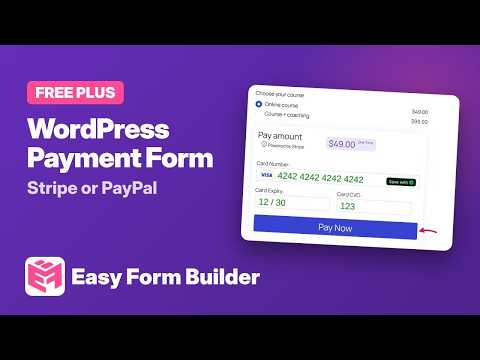
Click the price field on the canvas to open its settings (Edit). Set the Label and give every option a name and a price, here Online course at 49 and Course + coaching at 99. Then click the gateway field: Currency sets the currency, and Method payment sets one time or a Daily, Weekly, Monthly or Yearly interval.


Step 6 — Save the form and publish the shortcode
Click Save. The Good Job window shows the shortcode of the form, for example [EMS_Form_Builder id=4]. Click Copy Shortcode, paste it into a page or post (a Shortcode block works) and publish the page.

Step 7 — Test a payment as a visitor
Open the page in a private window. With Stripe, choose an option, enter the test card 4242 4242 4242 4242 with any future expiry date and any CVC (Stripe test cards) and click Pay Now. The form is submitted only after the payment succeeds, and the visitor sees a confirmation code.


A form with the PayPal field looks the same up to the amount. The first click on Pay Now loads PayPal’s own buttons, and the buyer completes the payment in the PayPal window; for a test, log in there with a PayPal sandbox buyer account.

Step 8 — Check the payments in WordPress
Open Easy Form Builder » Stripe Payments. The test payment is listed with its tracking code, payment type and amount, and the status Completed. Payments made through the PayPal field have their own list under PayPal Payments.

Donation, subscription and order forms
The same eight steps cover the common payment forms; only the price field or one setting changes.
- Donation form: add a Price Field so that donors type the amount themselves, then the Stripe or PayPal field.
- Subscription or membership form: in the gateway field set Method payment to Monthly (or Daily, Weekly, Yearly) instead of one time.
- Order form: use Payment Multi Choose for items and extras and Total Price to show the sum; the Create page also offers the templates Purchase Order Payment and Custom Order Form.
- Pricing page: preselect an option from a button with the steps in how to link pricing table buttons with a payment form.
Troubleshooting
| Symptom | Likely cause | Fix |
|---|---|---|
| The Payment Form template answers that you must first install a payment add-on | Neither the Stripe nor the PayPal add-on is installed | Install one of them (step 2) and reload the page |
| The payment fields are locked | The site is still on the Free plan | Switch to Free Plus (step 1) |
| Saving the form shows Error: No payment gateway has been added to the form. | The form has a price field but no Stripe or PayPal field | Add one gateway field (step 4) and save again |
| You cannot add reCAPTCHA to the form | Easy Form Builder does not allow reCAPTCHA on payment forms | Leave reCAPTCHA off on this form |
| The PayPal form shows only Pay Now, no PayPal buttons | The PayPal buttons load after the first click | Click Pay Now once; the PayPal buttons replace it |
| PayPal payments fail with sandbox credentials | Development mode is off, so the live PayPal servers are asked | Turn on Sandbox: On for tests (step 3); turn it off for live credentials |
Stripe payments fail and Stripe answers 401 | A wrong or outdated Secret Key (versions before 4.3.1 could replace it with a placeholder when settings were saved) | Update to 4.3.1, paste the Secret Key again and click Save |
| A Stripe payment stays Pending | The card is still being processed, or the visitor left before paying | Pending payments are re-checked in the background; a declined or abandoned attempt is marked Failed after an hour |
| Visitors see an old version of the form | A page cache or CDN served a cached copy | Purge the cache; see how to exclude forms from caching plugins |
Warning: Never post a Secret Key in screenshots, support tickets or page code. If one leaks, create a new key in the Stripe or PayPal dashboard and paste it into Settings » Payments.
Frequently asked questions
Is there a free WordPress payment form plugin?
Yes. Easy Form Builder is free on WordPress.org, and since version 4.3.1 its Free Plus plan includes Stripe and PayPal payment forms at no cost. Free Plus adds a small “Powered by Easy Form Builder” credit to the page that shows the form.
Do I need Easy Form Builder Pro to accept payments?
No. The Stripe and PayPal add-ons install on Free Plus and on Pro. Pro is needed for the Persia Payment add-on and removes the credit line.
Can I offer Stripe and PayPal in the same form?
A form works with one gateway. Create one form with the Stripe field and a second one with the PayPal field, and link to both.
Can a WordPress form take recurring payments?
Yes. In the Stripe or PayPal field, set Method payment to Daily, Weekly, Monthly or Yearly instead of one time.
Does Easy Form Builder charge a fee per payment?
No, the Free Plus plan is free of charge. Stripe and PayPal charge their own processing fees; Stripe lists them on its pricing page.
Which currencies can I use?
The Currency list has 136 currencies in the Stripe field and 24 in the PayPal field. Check the gateway’s own rules as well: Stripe supported currencies and PayPal supported currencies.
Does Easy Form Builder support Iranian payment gateways?
Yes, through the Persia Payment add-on, which connects ZarinPal. It is listed only on sites whose language is Persian and needs the Pro plan; it handles one-time payments.
Are card details stored in WordPress?
No. With Stripe the card fields are served by Stripe inside the form, and since 4.3.1 one-time payments are verified with Stripe on your server before the form is submitted. With PayPal the buyer pays in PayPal’s window.
What’s next
That’s it: you know which gateway and plan you need, and your WordPress payment form takes its first test payment.
- Stripe payment form in WordPress: the full setup guide — keys, test card and the Stripe Payments list in detail
- Set up PayPal payments in Easy Form Builder — Client ID, secret and sandbox
- Link pricing table buttons to a payment form
- Free, Free Plus and Pro: what each plan includes
Updated for Easy Form Builder 4.3.1 on . Rewritten as the payment overview: Stripe and PayPal now run on the free Free Plus plan (earlier versions of this guide asked for the Pro version), with a gateway comparison and new screenshots of every step.
