Email notifications help you know immediately when someone submits a form on your WordPress website. With Easy Form Builder, you can send automatic form notifications to administrators, managers, or the person who submitted the form, while controlling the recipient, subject, and information included in each message.
Easy Form Builder also includes a built-in email delivery test, so you can check whether WordPress can actually deliver your notification emails before relying on them.
This guide explains how to configure form email notifications, test email delivery, understand delivery warnings, and troubleshoot WordPress email problems.
Before you begin, make sure Easy Form Builder is installed and activated and that you already have a form you can edit.
Quick Answer
To set up form email notifications in Easy Form Builder:
- Go to Easy Form Builder > Panel.
- Edit the form you want to configure.
- Open Form Settings.
- Enter the email address that should receive form notifications.
- Choose what information the notification email should contain.
- Save the form.
- Go to Easy Form Builder > Panel > Settings > Email Settings.
- Verify the Admin Email and From Address.
- Click Check Email Server.
- Review the delivery result and email score.
If the email test fails or your notifications are not reaching the inbox, configure an authenticated SMTP service and run the test again.
1. Open Your Form
Sign in to your WordPress dashboard and navigate to:
Easy Form Builder > Panel
You will see the forms currently created on your website.
Find the form you want to configure and click Edit.

The Easy Form Builder editor will open with the selected form loaded.
2. Open the Form Notification Settings
Inside the form builder, open Form Settings.
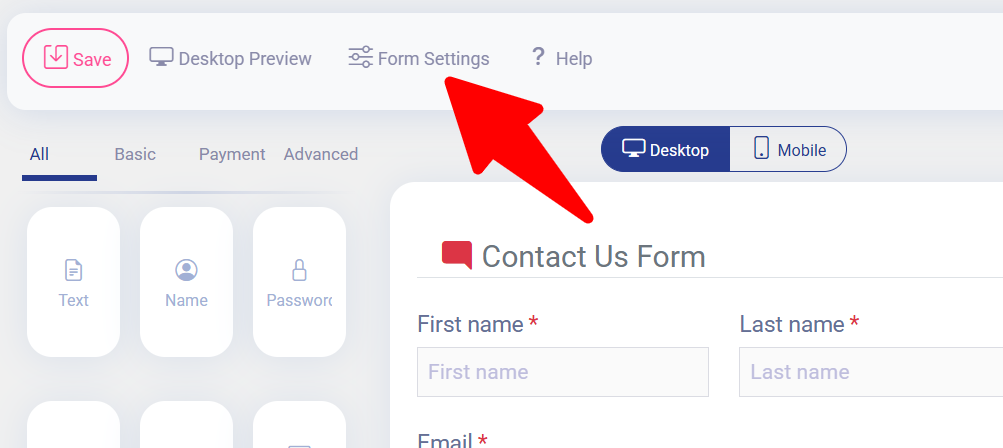
Form Settings contains the options that control the behavior of the selected form, including its email notification settings.
Each form can have its own notification configuration. This means, for example, your Contact Form can send notifications to your support team while your Sales Form sends notifications to your sales department.
3. Choose Where Form Notifications Are Sent
Find the field labeled:
Enter email address to receive notifications
This determines who receives an email when someone submits the form.
By default, Easy Form Builder may use your WordPress administrator email address.
You can replace it with another valid email address.
For example:
[email protected]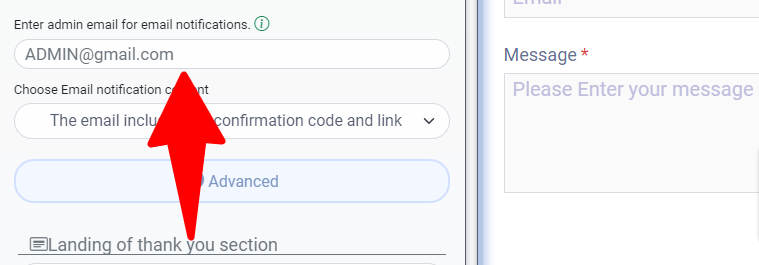
Make sure the address is correct before saving the form. A typo in the recipient address will prevent the intended administrator from receiving notifications even if your WordPress email server is working correctly.
Send Notifications to Multiple Email Addresses
You can also send a form notification to more than one recipient.
Enter multiple email addresses and separate them with commas.
For example:
[email protected], [email protected], [email protected]This is useful when several people or departments need to receive the same form submission notification.
Depending on your Easy Form Builder tier, custom notification recipients may require Free Plus or Pro.
4. Customize the Notification Email Subject
The Email Subject field allows you to customize the subject line used for notifications generated by this form.

For example:
New Support Request Receivedor:
New Website EnquiryUsing a descriptive subject makes it easier to identify different types of form submissions in your inbox.
If the field is left empty, Easy Form Builder uses its default notification subject.
The interface displays the reminder:
Leave empty to use default email subject.
Custom notification subjects are available with Easy Form Builder Free Plus and Pro.
5. Choose What the Notification Email Contains
Easy Form Builder lets you control how much of the submitted information appears directly inside the administrator notification email.
Open the:
Choose Email notification content
dropdown.

Depending on your current Easy Form Builder configuration, the available options include:
Send Email with Confirmation Code and Link
The notification contains a unique confirmation or tracking code and a link that allows the administrator to view the complete submission.
This is the default option.
It is useful when you prefer to keep the full submission inside your WordPress dashboard rather than placing all submitted information inside the email itself.
Send Email with Submitted Form Content and Link
This option includes the submitted form information directly in the notification email and also provides a link to view or manage the submission.
This is useful when administrators need to quickly read a new enquiry without first opening WordPress.
Send Email with Submitted Form Content Only
This option includes the submitted form data directly in the notification email without including a link to the submission dashboard.
Choose the option that best matches your workflow and privacy requirements.
6. Send an Email Notification to the Person Who Submitted the Form
Easy Form Builder can also send automatic email notifications to the person who completes your form.
First, make sure your form contains an Email field so Easy Form Builder knows where the notification should be delivered.
Add an Email field to the form if one does not already exist.
Then open the Email field settings and enable the email notification option for the submitter.


Save the form after enabling the option.
This can be used to send submission confirmations, acknowledgement messages, ticket notifications, or other automated messages to users.
Easy Form Builder version 4 also includes a visual email template editor that can be used to create branded notification emails without manually writing HTML.
Replying to a Submitted Form
Easy Form Builder also allows administrators to manage form submissions from the WordPress dashboard.
When an administrator replies to a submission using Easy Form Builder’s response system, the user can receive an email notification informing them that a new response is available.
This keeps form submissions and follow-up communication connected to the same workflow.
7. Save Your Email Notification Settings
After configuring the recipients, email subject, and notification content, click Save.

The notification settings are now associated with that form.
When someone submits the form, Easy Form Builder will attempt to send the configured notification through WordPress.
However, saving the settings does not automatically prove that your hosting server can successfully deliver email.
For that reason, the next step is important.
8. Test WordPress Email Delivery
Easy Form Builder includes a built-in email delivery tester.
Navigate to:
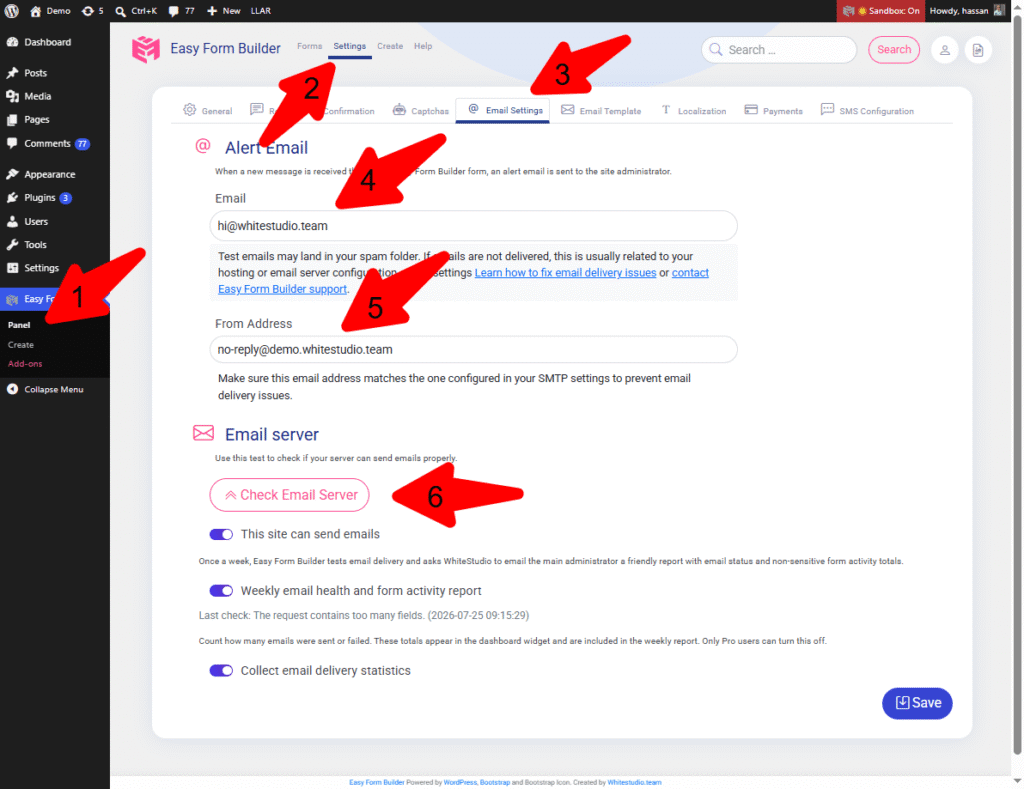
Easy Form Builder > Panel > Settings > Email Settings
Before running the test, review these two fields:
Admin Email
Enter a valid inbox where you can receive the detailed email delivery report.
From Address
Enter the real sender address that WordPress should use when sending Easy Form Builder emails.
The From Address should normally belong to your website domain or be an address approved by your SMTP or email provider.
For example:
[email protected]Avoid leaving an invalid, temporary, or unauthorized sender address in this field.
If you use an SMTP plugin, the From Address in Easy Form Builder should match the sender address authorized by your SMTP plugin or email provider.
When the settings are correct, click:
Check Email Server
9. What Does the Easy Form Builder Email Test Do?
The email test does more than check whether WordPress reports that an email was sent.
Easy Form Builder:
- Creates a unique test email address.
- Sends a real email through your WordPress website.
- Waits for the message to reach the test server.
- Verifies the received message.
- Displays the delivery status and score.
- Sends a detailed diagnostic report to the Admin Email.
This is important because WordPress can sometimes report that an email was successfully sent even though the receiving mail server never accepted or delivered it.
10. Understand the Email Delivery Score
After the test completes, Easy Form Builder displays a delivery result and score.
Score Above 70/100
A score above approximately 70 out of 100 generally indicates that the email configuration is healthy.
However, you should still review the diagnostic report for recommendations.
A successful test does not guarantee inbox placement with every email provider.
Score Below 70/100
The test message may have been delivered, but your email configuration could still have authentication, sender reputation, or DNS problems.
Check the report for issues involving:
- SPF
- DKIM
- DMARC
- Sender-domain alignment
- Email headers
- Sender reputation
- Unauthorized From Address
These problems can increase the chance of your WordPress emails being rejected or sent to the spam folder.
11. What If the Email Test Is Delayed?
Sometimes WordPress successfully sends the test message, but delivery takes longer than expected.
Possible reasons include:
- A slow outgoing mail queue
- Temporary spam filtering
- Delays at the SMTP provider
- Hosting server delays
- Temporary email service problems
Run the test again after checking your configuration.
Repeated delays should be investigated with your hosting provider or email provider.
12. What If the Email Test Times Out?
If Easy Form Builder sends the test but the test server never receives it, common causes include:
- Your hosting provider blocks outgoing email.
- SMTP credentials are incorrect.
- PHP mail is unavailable or disabled.
- Required SMTP ports are blocked.
- A firewall is blocking the request.
- Security rules are interfering with email delivery.
- The From Address is not authorized.
- Your SMTP provider rejects the sender.
Always review the Failure Reason reported by Easy Form Builder before changing random settings.
13. Understand the “Email Notifications May Not Be Delivered” Warning
You may see an orange warning after saving a form:
Email notifications may not be delivered
This warning indicates that form notifications are enabled but Easy Form Builder has detected that email delivery has not yet been properly verified or that the latest delivery score is below the recommended level.

The form itself is still saved.
However, administrator notification emails may not reliably reach their destination until the email delivery problem is resolved.
To investigate the warning:
- Go to Easy Form Builder > Panel > Settings > Email Settings.
- Verify the Admin Email.
- Verify the From Address.
- Click Check Email Server.
- Review the delivery score and diagnostic report.
- Fix any reported authentication or delivery problems.
- Run the test again.
14. Fix Failed WordPress Notification Emails with SMTP
Easy Form Builder sends email through WordPress’s email system.
Many WordPress installations initially rely on the hosting server’s default mail configuration. Although this may work, some hosting environments do not properly authenticate outgoing WordPress emails.
An SMTP plugin sends WordPress email through an authenticated mail server or supported email API, which can significantly improve reliability.
You can use WP Mail SMTP or another reliable WordPress SMTP plugin.
For the complete Easy Form Builder email testing and SMTP troubleshooting guide, see:
How to Test WordPress Email Delivery in Easy Form Builder
Information You May Need from Your Hosting Provider
If your hosting provider supplies SMTP service, you may need:
- SMTP Host
- Encryption type
- SMTP Port
- Authentication setting
- SMTP Username
- SMTP Password
Ask your hosting provider for the correct values if you are unsure.
Important: Match the From Address
When using SMTP, make sure the From Address configured in Easy Form Builder matches the sender address approved by your SMTP plugin or email provider.
A mismatch can result in:
- Rejected emails
- Rewritten sender addresses
- Failed authentication
- Messages being placed in spam
After configuring SMTP, return to Easy Form Builder and run Check Email Server again.
15. Troubleshoot Form Notification Emails
If form notifications are not arriving, work through these checks in order.
Check the Notification Recipient
Open the form and confirm that the administrator notification email address is correct.
Check the Spam or Junk Folder
The email may have been delivered but filtered by the receiving provider.
Check the From Address
Make sure Easy Form Builder is using a real and authorized sender address.
Run Check Email Server
Go to:
Easy Form Builder > Panel > Settings > Email Settings
and run the built-in delivery test.
Review the Delivery Score
A low score may indicate SPF, DKIM, DMARC, sender alignment, or reputation problems.
Review the Failure Reason
Use the reported failure reason as the first troubleshooting clue rather than changing multiple server settings at the same time.
Check Your SMTP Configuration
If you use SMTP, verify the host, port, encryption, username, password, and sender address.
Check Your Hosting Environment
Some hosting providers restrict PHP mail, SMTP ports, or outgoing connections.
Check WordPress or Server Errors
If the test produces an HTTP 500 or connection error, investigate:
- WordPress debug logs
- PHP error logs
- Security plugin rules
- Firewall configuration
- REST/AJAX restrictions
- Server configuration
An HTTP 500 error does not automatically mean your SMTP password is incorrect.
Frequently Asked Questions
Can each Easy Form Builder form send notifications to a different email address?
Yes. Email notification settings are configured per form, so different forms can send notifications to different administrators or departments.
For example, your Support Form could notify [email protected], while your Sales Form sends submissions to [email protected].
Can Easy Form Builder send notifications to multiple recipients?
Yes. Multiple email addresses can be entered in the notification recipient field and separated with commas.
Custom notification recipients are available with Free Plus and Pro.
Can I customize the email subject?
Yes. Easy Form Builder provides an Email Subject setting that lets you create a custom subject for notifications.
If you leave the field empty, Easy Form Builder uses its default subject.
Custom notification subjects are available with Free Plus and Pro.
Can the submitted form content appear directly inside the notification email?
Yes.
Easy Form Builder provides notification content options that can include:
- A confirmation code and link
- Submitted form content and a link
- Submitted form content without a dashboard link
Can Easy Form Builder send an email to the person who submitted the form?
Yes. Easy Form Builder supports automatic notifications to form submitters.
Make sure the form includes an Email field and configure the relevant email notification settings.
Does Easy Form Builder support custom email templates?
Yes. Easy Form Builder version 4 includes a visual email template editor that allows you to design notification emails without writing HTML.
Custom email templates are available in the Free version as well as Free Plus and Pro.
Why am I not receiving Easy Form Builder notification emails?
The most common reasons include:
- An incorrect recipient email
- An unauthorized From Address
- Hosting mail restrictions
- Missing or incorrect SMTP configuration
- SPF, DKIM, or DMARC problems
- Email provider filtering
- Messages being placed in spam
Run Check Email Server in Easy Form Builder to identify the problem.
Do I need SMTP to use Easy Form Builder?
Not necessarily.
Easy Form Builder can use WordPress’s normal email system, and some hosting environments deliver these emails successfully without additional configuration.
However, if messages are not arriving reliably, authenticated SMTP or an email API can improve email delivery.
What email delivery score should I aim for?
A score above approximately 70/100 generally indicates a healthy configuration.
A lower score does not always mean email completely fails, but it may indicate authentication, sender alignment, DNS, or reputation problems that should be fixed.
Does a successful email test guarantee that messages will reach the inbox?
No.
A successful test confirms that the test message reached the Easy Form Builder test server.
Inbox placement can still depend on:
- Email content
- Domain reputation
- IP reputation
- Recipient engagement
- Spam filters
- Email provider policies
Should the Easy Form Builder From Address match my SMTP From Address?
Yes, in most configurations.
Use the same approved sender address in Easy Form Builder and your SMTP plugin unless your email provider specifically supports a different aligned sender.
When should I run the email test again?
Run Check Email Server whenever you change:
- SMTP providers
- SMTP credentials
- From Address
- Mailer configuration
- DNS authentication records
- Hosting providers
- Security or firewall settings
You can run the test more than once.
Final Checklist
Before relying on Easy Form Builder email notifications, confirm that:
- Your form notification recipient is correct.
- The form has been saved.
- Your Admin Email is valid.
- Your From Address is authorized.
- You have run Check Email Server.
- The test email was delivered.
- Your delivery score is healthy.
- SPF, DKIM, and DMARC warnings have been reviewed.
- SMTP is configured if your normal WordPress email system is unreliable.
- You have submitted a real test form and confirmed that its notification reaches the expected inbox.
With these settings configured, Easy Form Builder can automatically notify your team or form submitters while giving you a built-in way to verify whether your WordPress email system is actually working.