Short answer: To create a multi-step form in WordPress, install the free Easy Form Builder plugin, open Create and pick New Form or the multi-step contact template, drag a Step element above each group of fields, choose a progress bar style, click Save and place the shortcode on a page. Steps are free.
Quick facts
- Plan: Free. The Step element, the multi-step templates and all progress bar styles work on the Free plan.
- Conditional steps: Free Plus (free of charge, up to 3 field rules) or Pro
- Time: about 5 minutes
- Tested with: Easy Form Builder 4.3.1 on WordPress 7.1.4
- Last verified:

Video transcript
Build a multi-step form in WordPress for free. In Easy Form Builder, open Create, and pick New Form, or the Multi-Step Contact us Template. Drag the Step element onto the form. Each Step starts a new page, with Previous and Next buttons. In Form Settings, pick a steps style, and a progress bar: Classic, Single bar, Segments, or Ring. Click Save, copy the shortcode, and paste it on any page. Visitors move one step at a time, and required fields are checked before Next. Get Easy Form Builder free on WordPress.org. The full guide is on whitestudio.team.
What is a multi-step form in WordPress?
A multi-step form (also called a multi-page form) shows a long form one part at a time, with Previous and Next buttons and a progress bar. Visitors see a few fields per screen instead of one long page. Common uses are registration forms, quote requests, job applications, bookings and surveys.
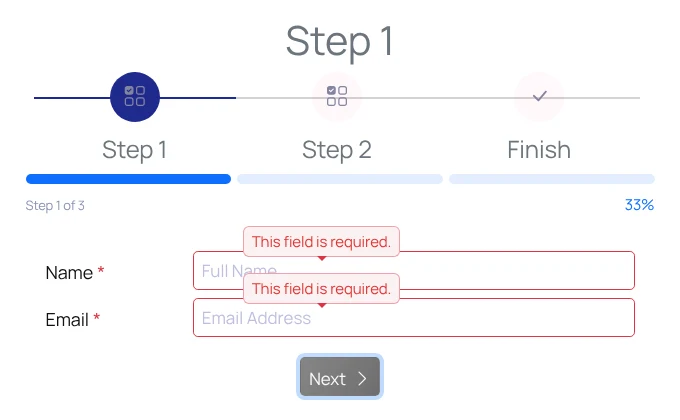
In Easy Form Builder, every Step element starts a new page of the form. The fields below a Step belong to that step until the next Step element. The plugin adds a final Finish step and shows “Step 2 of 3” with a percentage to the visitor.
Before you start
- Easy Form Builder installed and active (free on WordPress.org). See how to install and activate Easy Form Builder if you have not done it yet.
- A page or post where the form will appear.
Step 1 — Start a new form or the multi-step template
In the WordPress menu open Easy Form Builder » Create. Choose New Form (“Start a form from scratch with one or multiple steps”), or scroll to Multi-Step Contact us Template for a ready two-step form with Name and Email on step 1 and Message on step 2.

Step 2 — Drag a Step element to split the form into pages
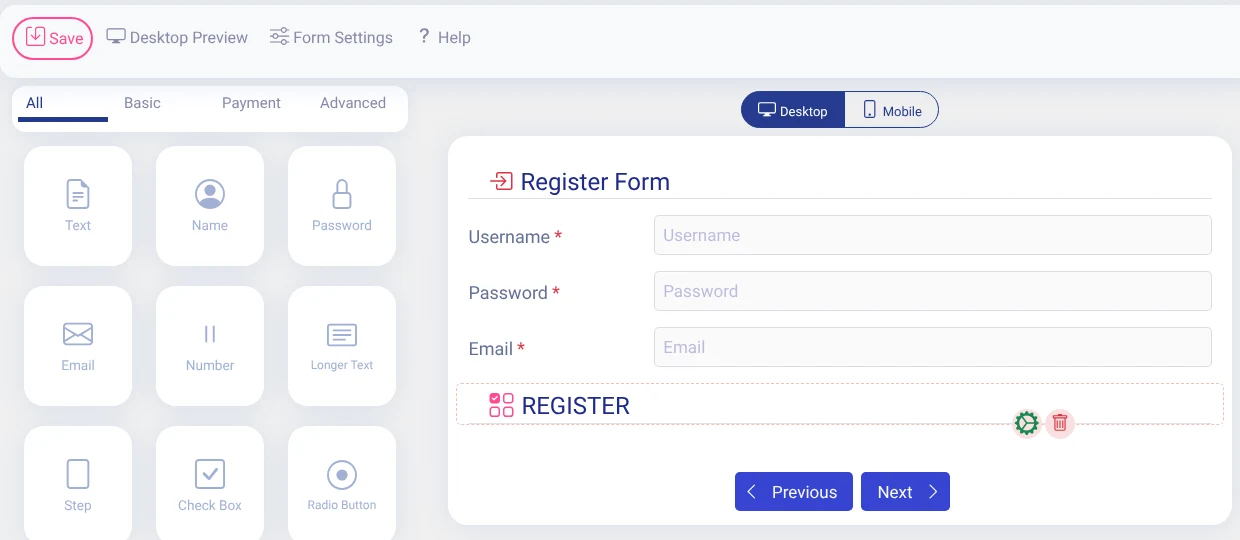
In the builder, the Step element sits in the field list on the left, next to Text, Email and Check Box. Drag it onto the form where the next page should begin, then drag the fields for that page below it. Repeat for every extra step. The Previous and Next buttons appear as soon as the form has two steps.
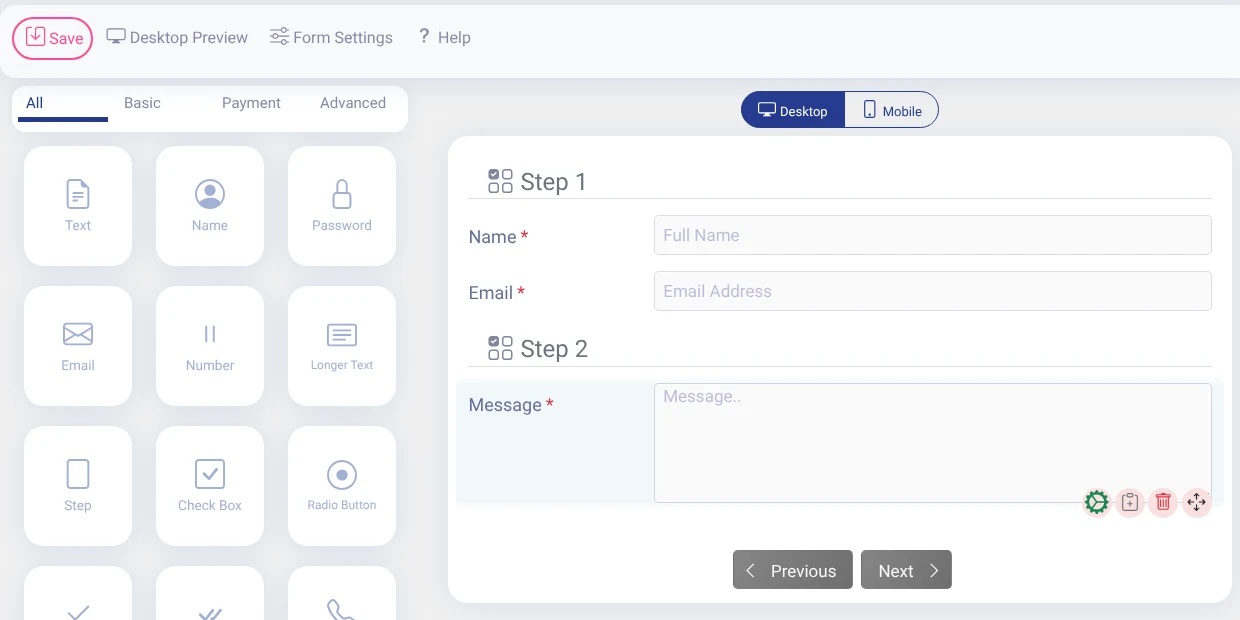
Plan the split before you drag: group fields the way a visitor thinks, for example “Your details”, “Project” and “Budget”, and keep each step short enough to fit one screen on a phone.
Step 3 — Choose the steps style and progress bar
Click Form Settings at the top of the builder. Two pickers control how the steps look on your page:
- Steps style: Classic, Circles, Pills or Ribbon. It appears when Hide icons and step names. is off.
- Progress bar style: Classic, Single bar, Segments or Ring. Turn on Hide progress bar if you do not want one.
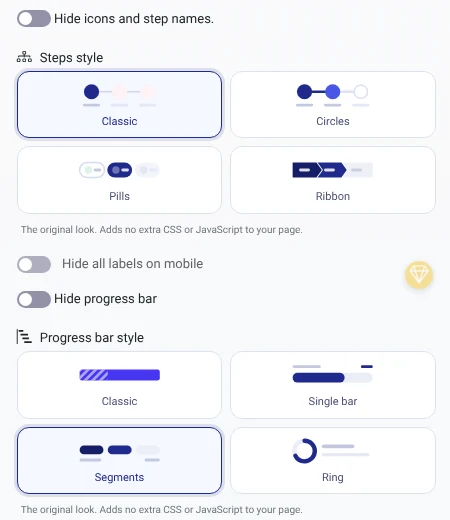
Classic is the original look and adds no extra CSS or JavaScript to your page. The other styles are included in the free plugin.
Step 4 — Save the form and add the shortcode to a page
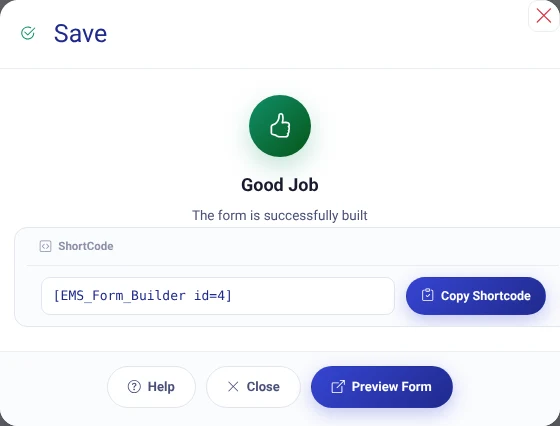
Click Save. The dialog shows the shortcode, for example
. Click Copy Shortcode, open the page in the WordPress editor, add a Shortcode block and paste it. Page builders such as Elementor have their own Shortcode widget that works the same way.
Step 5 — Test the steps as a visitor
Open the page in a private browser window. Each step shows its own fields, the progress bar moves, and the last step shows Submit instead of Next.
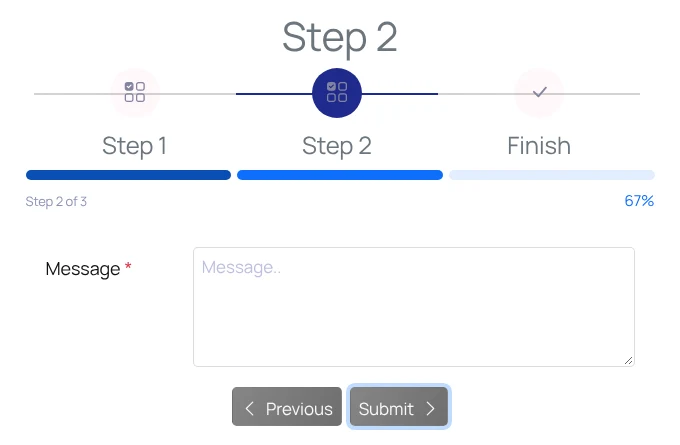
Required fields are checked before the visitor can move on. If a required field on step 1 is empty, Next stays on that step and shows “This field is required.” under the field.
Multi-step registration form in WordPress
Under Create, the Register Form template builds a WordPress user registration form with Username, Password and Email. It is free. To turn it into a multi-step registration form, drag a Step element below the account fields and add profile questions on the new step.
Multi-step form with conditional fields
With the Conditional Logic add-on, a rule can show or hide a field, show or hide a whole step, or jump to a step based on an earlier answer, for example skipping the “Company details” step when the visitor picks “Personal”. The add-on runs on Free Plus (free of charge, up to 3 field rules) and on Pro (no limit). Set it up with the Conditional Logic add-on guide.
Is there a free multi-step form plugin for WordPress?
Yes. Easy Form Builder builds multi-step forms on its Free plan. Here is what each plan includes for step forms:
| Feature | Free | Free Plus | Pro |
|---|---|---|---|
| Step element and multi-step templates | Yes | Yes | Yes |
| Steps style and progress bar styles | Yes | Yes | Yes |
| Required fields checked on each step | Yes | Yes | Yes |
| Email notifications | Yes | Yes | Yes |
| Conditional logic (show, hide or jump to a step) | No | Up to 3 field rules | Unlimited |
Free Plus costs nothing; switch to it under Panel » Settings » General » Plan Management. See Free, Free Plus and Pro: what each plan includes.
Troubleshooting
- Next does nothing. A required field on the current step is empty or invalid; the message appears under that field.
- The form shows but does not send on a cached page. Exclude the form page from page caching: exclude Easy Form Builder forms from cache.
- A 403 error after Submit. A firewall or security plugin blocked the request; follow fixing a 403 error after submitting a form.
Frequently asked questions
Can I make a multi-page form in WordPress for free?
Yes. In Easy Form Builder a multi-page form and a multi-step form are the same thing: each Step element starts a new page. The Step element is part of the free plan.
Can I create a multi-step form in WordPress without a plugin?
Only with custom HTML, CSS and JavaScript plus your own code to validate and store the answers. A form plugin handles the steps, validation, entries and email notifications for you.
Does a multi-step form work on mobile?
Yes. Use the Mobile tab at the top of the builder to preview it. We tested the form on a 390 px wide phone screen: each step, the progress bar and the Previous and Submit buttons fit without scrolling sideways.
Can I hide the step names or the progress bar?
Yes. In Form Settings, turn on Hide icons and step names. or Hide progress bar.
Does it work with Elementor or other page builders?
Yes. Paste the form shortcode into the page builder’s Shortcode widget or block.
What’s next
- Step settings inside the builder, in detail
- Show, hide or skip steps with conditional logic
- Create your first form with Easy Form Builder
- Make form fields required or optional
Updated for Easy Form Builder 4.3.1 on . Rewritten with every step re-tested on 4.3.1 and new screenshots, including the new steps and progress bar styles.